

Meet YESION at the 140th Canton Fair 2026
2026-10-13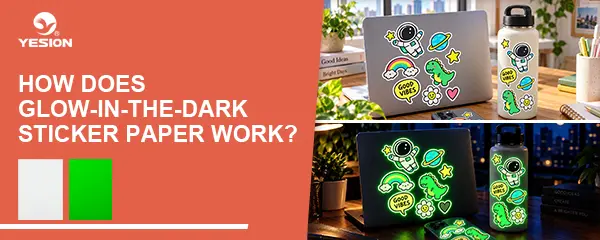
Glow-in-the-dark sticker paper works by absorbing light energy and gradually releasing it as visible light in darker environments. Its performance depends on the photoluminescent material, light exposure, surface structure and printing conditions. Understanding these factors helps printing businesses and product developers select suitable materials for customized sticker projects.
What Makes Glow-in-the-Dark Sticker Paper Glow?
The glow effect is generally produced by photoluminescent materials incorporated into the sticker structure. These materials absorb energy from a suitable light source and release part of that energy as visible light after the source is removed.
Unlike stickers that rely on LEDs or batteries, photoluminescent stickers do not require an electrical power supply to produce their glow.
The exact formulation and construction vary by product. Buyers should consult the manufacturer’s specifications rather than assume that all glow sticker materials provide identical brightness, color or duration.
What Materials Are Used in Glow Sticker Paper?
Photoluminescent Components
Photoluminescent pigments are responsible for the light-storage and emission effect. Their composition, concentration and distribution can influence the finished material’s glow characteristics.
Printable Surface
The printable layer allows designs to be reproduced using compatible printing systems. Surface properties can affect ink absorption, color reproduction and image clarity.
Adhesive and Release Liner
The adhesive helps the sticker attach to a suitable substrate, while the release liner protects the adhesive before application. These components influence handling and application but do not independently determine the strength of the glow.
How Does Light Activate the Glow Effect?
Glow activation involves three main stages.
1. Light Absorption
The material is exposed to a suitable source, such as sunlight, UV light or compatible artificial lighting. The photoluminescent component absorbs energy during exposure.
2. Energy Storage
The absorbed energy is temporarily retained within the material. The amount absorbed depends on the light source, its intensity, exposure time and the characteristics of the photoluminescent component.
3. Visible Light Emission
When the light source is removed, the material gradually releases stored energy as visible light. The glow generally becomes less intense over time.
UV light can be an effective activation source, but performance varies by formulation. Not every lamp or UV source produces the same result, so testing under actual operating conditions is recommended.
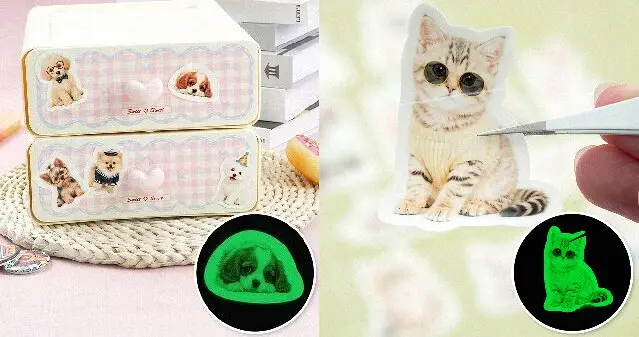
glow in dark stickers
How Does Printing Affect Glow Performance?
Printing adds another variable because ink and artwork can change how the finished sticker looks under normal and low-light conditions.
Ink Coverage
Large areas of printed ink may alter the amount of glow visible through the finished design. The effect depends on the ink, print density, material construction and design.
Artwork and Color
Fine details, solid colors and large graphic areas may produce different visual results. Designers should assess both daytime print quality and the appearance of the activated sticker in darkness.
Ink Compatibility
Using an incompatible ink or printing system can lead to poor adhesion, uneven coverage or unsatisfactory image quality. Confirm compatibility with the supplier before production.
For compatible products, inkjet printable sticker paper can support customized graphics without requiring the supplier to pre-print every design.
What Factors Affect Glow Performance?
Several factors can influence the appearance and duration of a glow sticker.
-
Light intensity: Stronger suitable light sources may activate the material more efficiently.
-
Exposure time: Insufficient exposure may result in a weaker initial glow.
-
Material formulation: Different formulations can produce different brightness and persistence.
-
Printed coverage: Ink coverage can affect the visible appearance of the finished design.
-
Ambient lighting: Surrounding light influences how easily the glow can be seen.
-
Viewing conditions: Distance, viewing angle and background can change the perceived brightness.
These variables explain why two stickers may look different even when they are made from materials described with similar product names.
How Can Businesses Evaluate Glow Sticker Quality?
For printing companies, importers and product developers, practical testing is more reliable than relying on a single performance claim.
A basic evaluation should include:
-
Expose samples to the same light source for the same amount of time.
-
Compare the initial glow under consistent dark conditions.
-
Observe how the glow changes over a defined period.
-
Check printed areas and unprinted areas separately.
-
Test adhesion and print quality on the intended application surface.
-
Record the results for comparison between samples or production batches.
For repeat orders, maintaining consistent testing conditions helps buyers assess whether the supplied material meets their requirements.
How Should You Choose a Glow-in-the-Dark Sticker Supplier?
Commercial buyers should request clear product specifications, printing compatibility information and samples for testing. Important considerations include material construction, adhesive characteristics, recommended printing systems, packaging and consistency between batches.
YESION provides printable specialty sticker materials for international customers. Buyers interested in printable glow-in-the-dark sticker paper can request product information and samples to evaluate suitability for their intended printing process.
The right material should be selected according to measurable project requirements rather than the product name alone.
