
Glow-in-the-Dark Sticker Paper vs. Regular Sticker Paper
2026-11-06Glow-in-the-dark stickers can remain visibly luminous for several hours after exposure to light, but their brightness gradually decreases over time. The actual glow duration depends on the photoluminescent material, charging conditions, surrounding light levels and viewing environment.
Some stickers produce a strong initial glow that fades relatively quickly, while others remain faintly visible for longer periods. This means glow duration and glow brightness are not the same measurement.
For manufacturers, importers and distributors, understanding this distinction is important when comparing different grades of glow-in-the-dark sticker paper.
Why Does Glow Brightness Decrease Over Time?
Glow-in-the-dark stickers do not maintain constant brightness throughout the night.
After absorbing energy from a light source, the photoluminescent material gradually releases that stored energy as visible light.
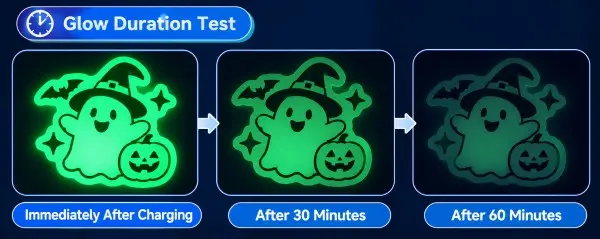
The glow typically follows three stages:
Initial Glow
Immediately after charging, the sticker usually appears brightest. This is when the luminous effect is easiest to observe and photograph.
Gradual Fading
As stored energy is released, the brightness decreases. The sticker may still be visible in a dark room even when its glow is much weaker than at the beginning.
Residual Glow
After an extended period, the remaining light may become difficult to detect without very dark surroundings or adapted eyesight.
The time at which a sticker is considered to have stopped glowing depends partly on the measurement method and visibility threshold.
What Factors Affect Glow Duration?
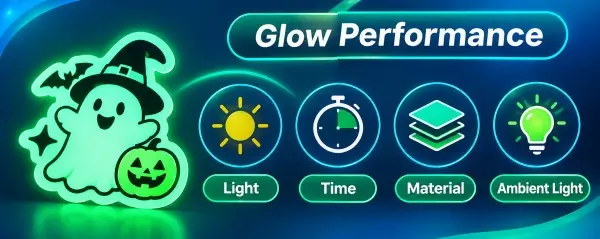
Several variables determine how long a glow-in-the-dark sticker remains visible.
Light Source and Charging Intensity
Sunlight, UV light and artificial lighting can activate photoluminescent materials, although their effectiveness varies.
A strong, suitable light source may produce a more noticeable glow than weak indoor lighting.
For consistent testing, use the same light source and distance when comparing samples.
Charging Time
Longer exposure can increase stored energy until the material approaches its effective charging capacity under the given conditions.
For some printable glow sticker materials, an initial exposure of approximately 10–15 minutes under suitable lighting may be used as a practical demonstration condition.
However, this should not be treated as a universal requirement. Actual charging performance depends on the material and light source.
Photoluminescent Material Quality
Different formulations have different brightness and afterglow characteristics.
Two sticker sheets may look similar in daylight but perform differently after charging.
This is why buyers should request performance information or samples instead of judging quality only by daytime appearance.
Ambient Light
A sticker may appear bright in a completely dark room but barely visible in a room with background lighting.
Ambient light does not necessarily change the material’s stored energy, but it strongly affects how the human eye perceives the glow.
Surface Printing and Design
Printed artwork can influence the visible luminous area.
For example, a sticker with large dark-colored printed sections may appear less luminous than a design that leaves more of the glow surface exposed.
For commercial printing projects, the artwork should be evaluated alongside the material itself.
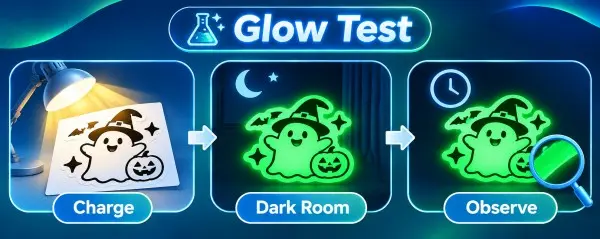
Glow Test
How Can You Test Glow Duration Accurately?
A simple comparison test can help determine whether a material meets the requirements of a particular application.
Step 1: Prepare Identical Samples
Cut several samples to the same dimensions. Keep printed and unprinted materials separate when possible.
Step 2: Charge Under Controlled Conditions
Expose all samples to the same light source, at the same distance, for the same amount of time.
Step 3: Move Samples Into Darkness
Place the samples in a dark environment and begin recording observations immediately.
Step 4: Compare Brightness at Set Intervals
Record the appearance after 1, 5, 15, 30 and 60 minutes. Continue testing at longer intervals if required.
For quantitative results, use suitable luminance-measuring equipment rather than relying only on photographs or visual impressions.
Step 5: Record the Results
Document the light source, exposure time, environmental conditions and observation method.
This information helps businesses compare materials more consistently across different suppliers and production batches.
Glow Performance
Does a Longer Glow Time Always Mean Better Quality?
Not necessarily.
A material with a longer afterglow is not automatically the best option for every application.
For example, decorative stickers used during short promotional events may benefit more from strong initial brightness.
Products intended for prolonged nighttime visibility may require a different balance between initial brightness and afterglow duration.
Other factors also matter, including printability, adhesive performance, surface finish and consistency between batches.
When evaluating printable glow-in-the-dark sticker paper, buyers should consider the complete product specification rather than glow duration alone.
Glow Duration Test
How Should Wholesale Buyers Evaluate Glow Performance?
Importers and distributors often need to compare products from multiple suppliers.
A practical evaluation should include:
-
Initial glow brightness after standardized charging
-
Visibility at several time intervals
-
Performance after repeated charging cycles
-
Consistency between different samples
-
Printed and unprinted glow appearance
-
Adhesive and printing performance
-
Packaging and storage requirements
Suppliers should also clarify whether stated glow duration refers to instrument-measured afterglow or visual observation.
A claim such as “glows for several hours” is difficult to compare unless the testing conditions are specified.
For distributors building a product range, documented sample testing can reduce uncertainty when introducing new specialty sticker materials.
Can Glow-in-the-Dark Stickers Be Recharged?
Yes. Photoluminescent stickers can generally be activated repeatedly by exposure to suitable light.
Their glow does not depend on a disposable battery.
However, repeated charging capability should not be confused with unlimited product durability.
Long-term performance can also be affected by the material formulation, environmental exposure, surface damage and storage conditions.
Businesses should distinguish between three separate characteristics:
Glow duration: How long the material remains visibly luminous after one charging cycle.
Rechargeability: Whether the material can absorb light and glow again.
Service life: How long the finished sticker maintains acceptable performance during use.
These characteristics should be evaluated separately.
Choosing Glow Sticker Paper for Different Applications
Different applications require different performance priorities.
| Application | Important Consideration |
|---|---|
| Halloween decorations | Initial brightness and visual impact |
| Children’s craft stickers | Print quality and decorative appearance |
| Novelty product labels | Glow consistency and adhesive compatibility |
| Promotional stickers | Design flexibility and production cost |
| Night-themed stationery | Glow appearance and surface finish |
| Specialty retail sticker collections | Product differentiation and repeatable quality |
Glow-in-the-dark decorative sticker paper should not automatically be considered suitable for regulated safety signage or emergency-exit applications. Such uses may require specific certified materials and performance standards.
The performance of glow-in-the-dark stickers depends on more than a stated number of glowing hours.
Initial brightness, charging conditions, afterglow visibility and application requirements all influence whether a particular material is suitable for commercial use.
For importers, wholesalers and distributors, standardized sample testing provides a more reliable basis for supplier comparison.
YESION supplies glow-in-the-dark sticker paper for printable decorative stickers and customized applications. Buyers can contact our team to discuss material specifications, sample evaluation, wholesale supply and packaging requirements.
Related:
What Is Glow-in-the-Dark Sticker Paper?
How Does Glow-in-the-Dark Sticker Paper Work?
How to Print on Glow-in-the-Dark Sticker Paper with Inkjet Printers
What Can You Make with Glow-in-the-Dark Sticker Paper?
Glow-in-the-Dark Sticker Paper vs. Regular Sticker Paper
