

How Long Do Glow-in-the-Dark Stickers Glow?
2026-11-13
Before placing a bulk order for printable vinyl sticker paper, evaluate the complete material construction—not only the surface finish or unit price. Buyers should confirm the face material, ink-receptive coating, adhesive, release liner, printer compatibility, converting performance, durability, packaging, and batch consistency. A controlled sample test on the actual printer and application surface is the most reliable way to reduce quality disputes and costly reorders.
This guide explains how importers, distributors, Amazon sellers, and print shops can qualify printable vinyl in a practical and repeatable way.
Start With the Final Application
A supplier cannot recommend the right printable material without knowing how the finished sticker will be produced and used. The same sheet may perform well on an indoor storage box but fail on a refrigerated bottle, a curved cosmetic container, or a frequently handled tool.
Define these conditions before requesting samples:
- Application surface: glass, metal, coated paperboard, PET, PP, PE, painted surfaces, or another substrate
- Surface shape: flat, curved, narrow-radius, or irregular
- Printing method: inkjet or laser, including printer model when possible
- Ink or toner type: dye ink, pigment ink, or laser toner
- Finished use: indoor, short-term outdoor, refrigerated, humid, or high-contact
- Desired removal: permanent, removable, or repositionable
- Finishing process: contour cutting, die-cutting, cold lamination, or no laminate
- Target service life and acceptable appearance
Surface energy, contamination, texture, temperature, and curvature can all change adhesive performance. Test on the customer’s real container or substrate rather than relying only on a generic adhesion claim.
Check the Face Material and Construction
The term “printable vinyl sticker paper” is often used broadly. Different products may use paper-based face stock, PP film, PET film, or other synthetic materials. These options differ in tear resistance, flexibility, dimensional stability, appearance, and cost.
Yesion’s printable adhesive paper range includes self-adhesive photo paper and several printable film finishes. Buyers should compare products by construction and intended application instead of assuming that every printable sticker sheet is interchangeable.
| Material direction | Typical characteristics to evaluate | Common buyer priorities |
|---|---|---|
| Paper-based adhesive media | Print appearance, tear behavior, coating, liner flatness | Indoor labels, photo stickers, cost control |
| PP printable film | Flexibility, water resistance, feeding, finish consistency | General labels, curved containers, everyday stickers |
| PET printable film | Tear resistance, dimensional stability, specialty finishes | Premium labels, durable decals, specialty effects |
| Clear or translucent film | Transparency, haze, white-ink requirement, edge visibility | Glass, windows, transparent packaging |
| Metallic or textured film | Surface uniformity, ink holdout, cutting behavior | Premium packaging, promotional stickers |
For a more focused material comparison, review PET vs. PP printable sticker paper before selecting sample grades.
Evaluate Print Compatibility With Your Equipment
“Inkjet printable” is not a complete specification. A material may behave differently with dye and pigment inks, different ink loads, printer feed paths, or environmental conditions.
During sample testing, check:
- Feeding reliability: Run multiple sheets, not just one. Watch for skewing, double feeding, head strikes, or jams.
- Drying behavior: Inspect immediately after printing and again after the supplier’s recommended curing period.
- Color density: Use a test file containing solid colors, gradients, small text, and neutral gray areas.
- Coating uniformity: Look for pinholes, streaks, mottling, uneven gloss, or areas that reject ink.
- Smudge resistance: Handle the sample under a repeatable method after the defined drying time.
- Cutting performance: Test the actual Cricut, Silhouette, plotter, or sticker cutting machine used by the customer.
- Lamination compatibility: If a laminate is required, check for silvering, trapped air, edge lifting, or color change.
Do not assume that one printer setting works for every finish. Glossy, matte, clear, metallic, and textured products can require different media settings and ink limits. Yesion’s PET translucent vinyl sticker paper is an example of a specialty finish that should be evaluated for both transparency and printed color appearance.
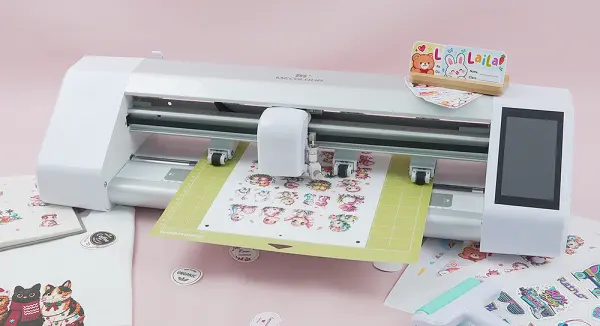
Cutting sticker
Inspect the Printable Coating
For inkjet media, the coating is responsible for receiving and controlling liquid ink. A visually attractive base film can still produce poor results if the coating is inconsistent.
Ask the supplier what the material is designed to support, then confirm the answer with printed samples. Important observations include:
- Sharpness of small text and fine lines
- Bleeding between adjacent colors
- Banding or uneven color density
- Ink pooling in heavy coverage areas
- Surface tack after drying
- Cracking when the sheet is bent or cut
- Changes after water, abrasion, or lamination tests
Compare several sheets from the sample pack and, when possible, samples from more than one production lot. A single perfect sheet does not prove batch consistency.
Test the Adhesive on the Actual Substrate
Adhesive performance depends on the application surface. Smooth glass and metal are generally easier to label than some low-surface-energy plastics. Dust, oil, condensation, texture, and tight curves can reduce the available contact area and cause edge lifting.
Include the following in an adhesive test:
- Initial tack immediately after application
- Adhesion after a defined dwell period
- Edge lifting on curved containers
- Performance after refrigeration, humidity, or temperature cycling
- Residue after removal, when a removable product is required
- Adhesion after light cleaning of the application surface
- Compatibility with plasticized or coated substrates
Record the substrate, preparation method, application pressure, dwell time, temperature, and test result. A statement such as “strong adhesive” is not useful unless the test conditions are known.
If your project uses a paper face rather than a synthetic film, the construction also matters. For example, Yesion’s 115gsm glossy self-adhesive photo paper combines a cast-coated face, water-based adhesive, and release paper; buyers should test the complete construction as a system.
Do Not Ignore the Release Liner
The release liner affects far more than peeling. It influences sheet flatness, printer feeding, die-cutting, kiss-cut depth, storage stability, and packing efficiency.
Evaluate:
- Liner thickness and stiffness
- Flatness before and after printing
- Release force consistency across the sheet
- Easy removal without premature separation
- Liner tearing or fiber contamination
- Cutting depth tolerance
- Curl after temperature and humidity exposure
- Back printing or custom back-mark requirements
For private-label products, also confirm whether the liner will remain blank or carry a repeated logo, instructions, grid, or batch information. Back printing should be approved separately because it can affect appearance, lead time, and minimum order requirements.
Build a Repeatable Quality Test Plan
A useful approval process does not need to be complicated, but it must be documented. Use the same printer, artwork, cutting method, application surface, and inspection conditions for every candidate material.
| Test area | Suggested check | What to record |
|---|---|---|
| Appearance | Gloss, color, haze, surface defects | Sample ID and visual result |
| Dimensions | Sheet size, thickness, squareness | Measuring method and tolerance |
| Printing | Feeding, color, drying, smudging | Printer, ink, setting, drying time |
| Cutting | Kiss-cut and full-cut behavior | Machine, blade, pressure, speed |
| Adhesion | Initial tack, dwell, edge lift | Substrate, temperature, time |
| Durability | Water, rub, scratch, bend | Exposure method and pass criteria |
| Liner | Release, curl, tearing | Conditioning and handling result |
| Packaging | Flatness and transit protection | Pack count, bag, carton condition |
Avoid pass/fail descriptions such as “good quality.” Define measurable or observable acceptance criteria before testing. Keep approved samples as reference standards for future incoming inspections.
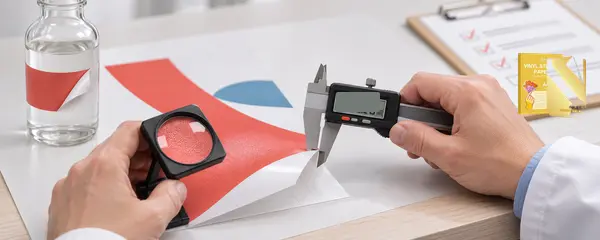
sticker paper Quality Test
Confirm Converting and Packaging Requirements
Bulk orders frequently fail because the material is acceptable but the converting or packaging does not match the buyer’s workflow.
Confirm these details in the quotation:
- Sheet or roll format
- Finished dimensions and dimensional tolerance
- Face material and surface finish
- Adhesive type
- Liner construction
- Pack quantity
- Inner bag or moisture-protective packaging
- Carton quantity, carton markings, and pallet requirements
- Blank or branded back printing
- Retail packaging, inserts, barcode, and labeling
- Sample approval process
- Pre-production sample requirements
- Inspection criteria and handling of nonconforming material
Amazon sellers should also verify retail pack dimensions, pack weight, suffocation warnings where applicable, barcode placement, and protection against bent corners. Importers and distributors should focus on carton strength, moisture protection, consistent pack counts, and SKU identification.
Compare Total Cost, Not Only Sheet Price
The lowest quoted price may produce a higher total cost if the material creates printer jams, slow drying, cutting waste, customer returns, or inconsistent reorders.
Calculate the commercial impact of:
- Usable sheets per pack
- Printing waste rate
- Cutting and weeding efficiency
- Additional laminate or sealant requirements
- Repacking labor
- Customer complaints and returns
- Reorder consistency
- Freight efficiency and carton utilization
A slightly higher material cost can be economical when it reduces production interruptions and after-sales problems.
Common Bulk-Buying Mistakes
Avoid these frequent sourcing errors:
- Approving a material from photos without printing it
- Testing on glass but using the final label on PP or PE containers
- Checking print quality but ignoring the liner and cutting process
- Treating “waterproof” as a complete performance specification
- Approving one sheet without checking repeatability
- Comparing quotes with different constructions or pack quantities
- Finalizing packaging after the material order has already started
- Failing to retain an approved reference sample
Request Samples Before Final Approval
A bulk printable vinyl order should begin with a clear application brief and controlled sample evaluation. Tell the supplier your printer, ink, application surface, environment, dimensions, finish, adhesive requirement, cutting method, packaging, destination country, and expected quantity.
Yesion offers multiple printable adhesive media for labels, decals, packaging, and customized projects. To discuss the right grade and obtain an accurate quotation, send your printable vinyl requirements to Yesion. Sample testing should be completed on your actual equipment and application surface before mass production.
Related Reading
